Intel X25-M SSD Review

Author

Dee
Senior Administrator and Reviewer
Article posted 13 Sep 09 22:20

Introduction


Review: Intel X25-M
Reviewed by: Dee
Provided by: Intel NL
Model: SSDSA2MH080G1GC

Intel NL was kind enough to send us their "mainstream" solid state drive for review, the MLC based 80GB X25-M series. The X25-M series of drives have a 2.5 inch form factor, SATA2 connection and SATA power connector. The X25-M series can be fitted to a laptop with SATA hard drive support, or as we have done for this review, the Intel X25-M series can also be fitted to a desktop PC which supports SATA hard disk drives.

In this review we will test the performance and usability of the Intel X25-M series (MLC) SSD. When Intel introduced the X25-M series of SSD drives, Intel at a single stroke changed forever the perception of SSD, there was simply nothing that could match the Intel X25-M series of drives in the mainstream sector for performance. Things have changed, and the Intel X25-M now has some serious competition in this market sector. Let’s find out how the Intel X25-M SSD performs in our tests.

Intel Company Information

I’m sure most CD Freaks members will be familiar with the Intel brand name. Intel has been manufacturing high performance CPU’s, motherboard chipsets, and other PC related hardware for many years.

More recently, Intel ventured into the SSD market and caused quite a stir in the process.

If you would like to find out more about Intel, you can visit Intel’s website.


Packaging

Box front

Box rear
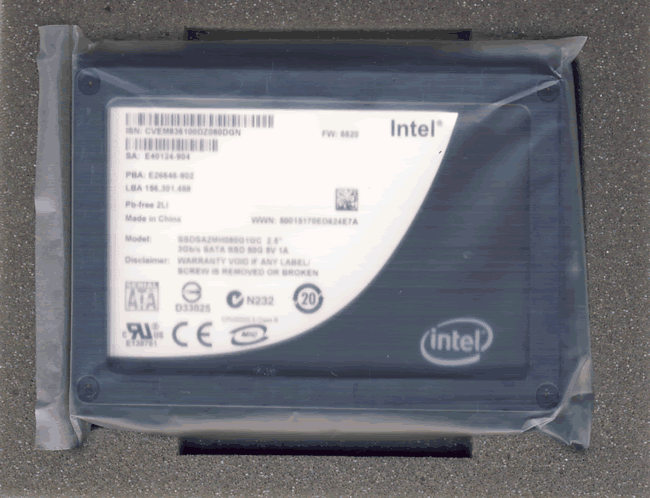
Box inner packing

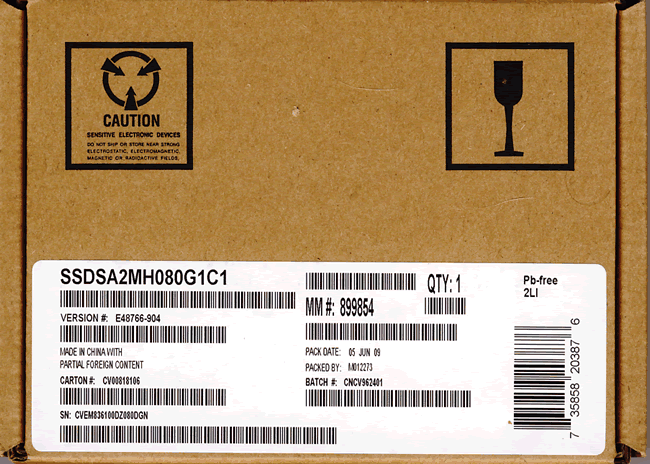
Not much can be said about the box that the Intel X25-M came shipped in. The box is made from plain brown coloured cardboard. Inside the main box is a further box and more robust packaging. The inner box is made from tough cardboard with foam protection. The drive itself is housed in an anti static bag. There should be no problem with the way the drive is packaged.

What’s inside the box

Now it’s time to take a look at the drive itself and what the drive came shipped with.
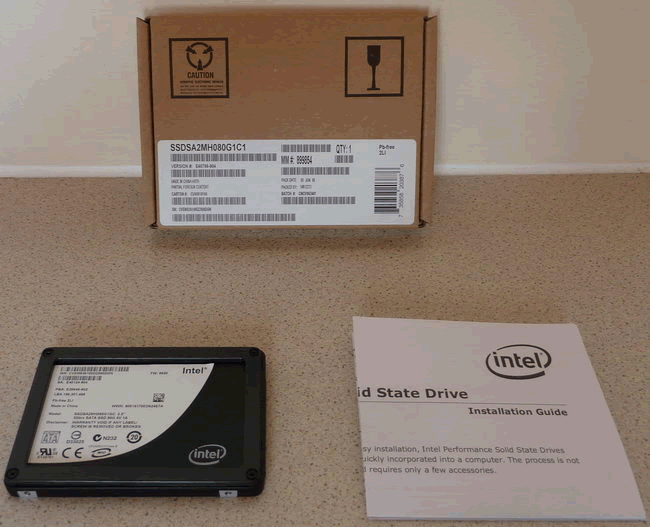
The package contained the drive itself and instruction booklet.

Now let’s take a look at the drive itself.
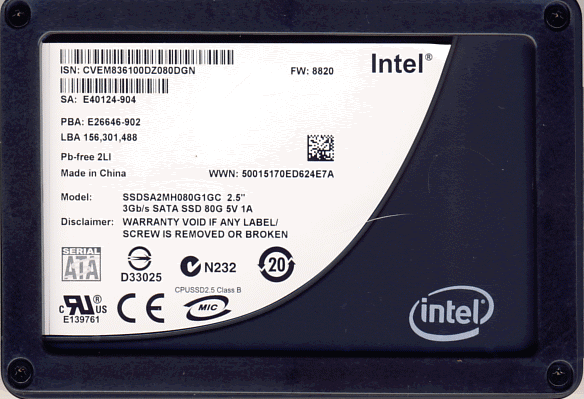
Drive top

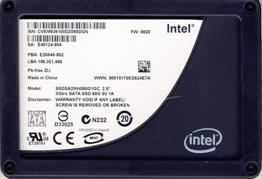
On the top of the drive we can see a single label. The label states the drive model number and capacity and that the drive was manufactured in China. The label also lists the drive part number and serial number
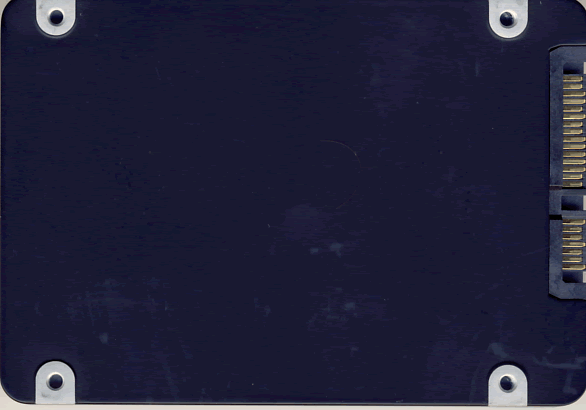
Drive bottom

The bottom of the drive is plain, but we can also see the drive’s SATA power and data connectors.

Drive rear

On the rear of the drive we can see the SATA power and data connectors.

The Intel X25-M is well constructed, in a strong metal housing.

Now let’s head to the next page, where we look at the drive’s features.

 

12 Comments

Markstar
Posts: 62
Posted on: 14 Sep 09 11:56
Wow. Dee, I have all the respect in the world for you, but a review about an obsolete drive where the successor is not only better (TRIM(!), improved IOPS and more), but also cheaper.

Since Intel announced that the G1 drives would not get TRIM, there is simply no reason not to get a G2 drive and therefor I find the conclusion of the article very misleading.

This would have been a good review a year ago, but now it reads like Intel paid you to review this so they can get rid of their old stock. A link to Anandtechs excellent article ( http://www.anandtech.com/storage/showdoc.aspx?i=3631&p=1 ) would have saved you time and a more up-to-date insight into Intels current SSD.
Dee
Posts: 11995
Posted on: 14 Sep 09 14:28
The G2 series drive was requested, but had been withdrawn from the market to fix a firmware bug, so Intel sent the G1 instead.
I'm also well aware of the G2 series drives, it has the same strengths as the G1 (4k Random write performance) and the same weakness (slow sequential write performance) and TRIM wont solve sequential write performance.

If Intel wishes to send the G2 for review, then i'm happy to compare to any other drive.
I also NEVER have been paid to review anything, and would never accept reviewing something under those conditions.
Markstar
Posts: 62
Posted on: 14 Sep 09 16:16
Quote:
Originally Posted by Dee View Post
The G2 series drive was requested, but had been withdrawn from the market to fix a firmware bug, so Intel sent the G1 instead.
Yeah, but it's available now.
Quote:
I'm also well aware of the G2 series drives, it has the same strengths as the G1 (4k Random write performance) and the same weakness (slow sequential write performance) and TRIM wont solve sequential write performance.
No, but it will improve performance in the long run.

Quote:
If Intel wishes to send the G2 for review, then i'm happy to compare to any other drive.
I also NEVER have been paid to review anything, and would never accept reviewing something under those conditions.
I am absolutely confident that your test was totally unbiased, I just wrote that the article sounded like that. It was really strange reading a review of an old drive without referring the G2, especially not in the conclusion.

As I wrote before, I think it is a good review, but ignoring the G2 means that there is an important perspective of the current market situation is missing. In your conclusion, you even mention the G2, but only offer a link where one can get the old drive. If I had only read your test, I would be left with the impression that while the G2 is out, it does not offer any substantial advantages over the G1 and the G1 is still the best choice (if I don't care about sequential write speeds). But that's simply not true and everybody who is aware of the current situation knows that the G2 is the drive to get.

Again I would like to stress how much I respect your work so I wouldn't want to tell you how to write your reviews, but it's September, 2009 and even if you decide to write about the G1 (which I honestly don't see the point), at least tell your readers that there is a better alternative available.

Just my .02, keep up the good work.
Dee
Posts: 11995
Posted on: 14 Sep 09 19:10
I believe i already told the readers that a better alternative was available. I also suspect that the following section was overlooked by you?

Quote:
4K random write performance Vs the rest
The Intel X25-M has 4K random write bandwidth by the truck load, it has a vast amount of 4K random write headroom to spare, when the drive is used in a typical mainstream PC work pattern. By mainstream work pattern we mean what we would describe as a normal PC users work pattern. This would include surfing the Internet, downloading some files, and email sending and receiving, some word processing, some editing and moving picture data around, moving and editing MP3 files around, editing and saving some video and music files, and perhaps also playing a few games.

The problem with the above user pattern is: None of these tasks require high 4K random writing performance, so most of this 4K random read/write performance is left untapped. It’s not until the usage pattern becomes more workstation like, that the Intel X25-M starts to shine, and we ask how many mainstream PC users use their PC in this way. In fact, the Intel X25-M SSD is aimed at the mainstream user, not the enterprise workstation market.

We know the SSD controller inside the Intel X25-M is a powerful one, we can see this by the drive’s 4K random writing performance, surely Intel could allow some more cycles for sequential writing performance, as this really hurts the X25-M performance, and what is more, the slow sequential writing performance is something that is noticeable between the X-25M and the Indilinx drives. While the Intel X25-M does have far superior 4K random writing performance over the Indilinx drives, it doesn’t make the Intel drive feel faster in mainstream use, simply because 4k random writing performance in the Intel X25-M remains largely untapped.

Adding to this, Intel just recently released the G2 series of Intel X25-M SSD, and haven’t really improved the sequential writing performance of this new series, in fact, they have further improved 4k random performance, and sequential writing performance has once again been left out.
Aramchek
Posts: 230
Posted on: 14 Sep 09 22:50
Quite informative, thank you!
As many have already pointed out, while SSDs are very nice (as long as they have a controller that isn't from jmicron) they are also very expensive.
Intel managed to lower prices and increase performance thanks to moving flash memory production to a new fab process - smaller feature size having the dual benefits of more chips / wafer assuming similar yields and typically higher performance potential. Obviously Intel is not going to move to a new process again for some time, but what about the other flash memory manufacturers? Does anyone know if any of them are likely to lower their prices in the reasonably near future?

There is a new log structured file system for Linux called NILFS. It would be interesting to see how well it would work on an SSD. Its main advantage over normal file systems on a classic hard disk is that write latency won't be as much of a problem, which obviously is irrelevant on SSDs. However, depending on how different SSD controllers handle wear levelling, block-erase-avoidance (for lack of better term) and related issues, it might end up a good match. I'm under the impression that the way these file systems work is quite similar to the low level functionality of many SSDs (i.e., how they actually write to the flash chips, rather than how they present them to the OS).
Markstar
Posts: 62
Posted on: 14 Sep 09 22:54
Look, I don't want to argue with you. I really think you are doing a great job and don't want to sound like a complaining nitpicking bastard. All I wanted to emphasize to potential readers that the G1 really is old news by now and the G2 is the one to get if you're going down the Intel path. I have not overlooked the part you bolded, but I still think that the G2 should have gotten a few more lines throughout the review and I still don't understand how you can recommend a drive (btw, the G1 is not available through the link you provided anymore) when a better successor is already available for a better price (unlike most other new gadgets, where you pay a premium for them being new on the market).

OTOH, I'm just a random guy on the internet, so please feel free to ignore me. I really do not wish to go against a guy who made my computer experience (and that of thousands of others) that much better.

Cheers
Dee
Posts: 11995
Posted on: 14 Sep 09 23:17
I'm not arguing either. The drive i was sent to review was the G1 series, and that is the drive i reviewed, that is all i could test. I have requested a G2 series (again), and will test if Intel send one.

You'll also note that i said the X25-M is great drive, the G2 series is still called the X25-M, so i have no hesitation in recommending the X25-M, although i personally feel the Indilinx based drives suit my usage pattern better, as it will with many other users.

Quote:
I really do not wish to go against a guy who made my computer experience (and that of thousands of others) that much better.
If this sentence was aimed at me, then i thank you for the comment, but i would like to point out, that i'm NOT a guy.

@Aramchek
Thanks for the comments. I have been looking at this new Linux file system, and indeed it looks very interesting. The problem with Linux (although i like Linux) is, it's not nearly so much used as Windows but, i do intend to investigate this file system, and see what it has to offer.

RE new NAND.
Many manufacturers are now moving to either 34nm or 32nm fab processes, including Samsung and Toshiba. Micron has already made the move, as seen in the G2 series of Intel drives.
Hopefully, this will drive down NAND prices.
iceburg
Posts: 11
Posted on: 17 Sep 09 19:51
I was lucky to pick up G2 just before they were gone on launch($225). Awesome drive and my Xubuntu tablet loves it. Intel will be coming up with 40 GB version soon
rj_wilson
Posts: 19
Posted on: 24 Sep 09 17:46
Thanks for your review. Since I don't know exerything, I like to hear from people who see or know things I do not. Thank you for your work.
jjjtuohy
Posts: 10
Posted on: 24 Oct 09 00:38
What an entertaining & informative thread
Chriscreative
Posts: 72
Posted on: 12 Nov 10 05:37
Thanks for your review Dee, any info and review’s are interesting, can you help me understand why NAND flash prices are so high. As I heard up to 90% of the price on a SSD.
Dee
Posts: 11995
Posted on: 17 Nov 10 00:24
Quote:
Originally Posted by Chriscreative View Post
Thanks for your review Dee, any info and review’s are interesting, can you help me understand why NAND flash prices are so high. As I heard up to 90% of the price on a SSD.
Supply and demand in most cases regulate the price of NAND. Apple is also reported to consume 60% of all NAND made.
If you can sell more NAND than you can make, why not charge a premium price for it?

Post a comment

Hello guest,
default
To benefit from all extra features you need to log in or sign up.

About this category

Solid State (ssd)

  • Relatively new way of storing data in PCs / Laptops. Solid State Drives (SSDs) have no moving parts which means they're completely silent. Another advantage is that the more expensive SSDs offer better performance than traditional hard disk drives. However, the prices for these more advanced drives are still rather high and the storage capacity relatively low, preventing SSDs to go mainstream still.More about this
FAQsShould I buy a netbook with a SSD or with an HDD drive?How much space is left after I install an OS on my SSD?