OCZ Technology Vertex Series 120GB SSD Review

Author

Dee
Senior Administrator and Reviewer
Article posted 26 Feb 09 21:00

Introduction and features


Review: OCZ Vertex 120GB MLC SSD Reviewed by: Dee-27 Provided by: OCZ Technology Model: Vertex 120GB

OCZ Technology was kind enough to send us their latest “high performance” solid state drive for review, the MLC based 120GB Vertex series. The Vertex series of drives have a 2.5 inch form factor, SATA2 connection and SATA power connector. The Vertex series can be fitted to a laptop with SATA hard drive support, or as we have done for this review, the Vertex series can also be fitted to a desktop PC which supports SATA hard disk drives.

The OCZ Technology Vertex series are pretty unique, in that they have built-in cache.

In this review we will test the performance and usability of the OCZ Technology Vertex series (MLC) SSD. Just a few short weeks ago, we reviewed the OCZ Technology Apex series drives, and were very impressed by the performance. Let’s find out how the Vertex series drive performs.

OCZ Technology Company Information

I’m sure most CD Freaks members will be familiar with the OCZ Technology brand name. OCZ Technology has been manufacturing high performance, high quality PC memory and flash memory for many years.

More recently, OCZ Technology ventured into the SSD market and has done more than most manufacturers to bring affordable and high performance SSD drives to the mainstream PC user.

If you would like to find out more about OCZ Technology, you can visit the OCZ Technology website.

Packaging

Box front
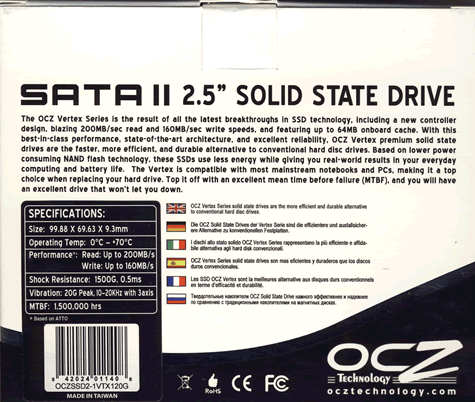
Box rear
Box top
Box left and right sides

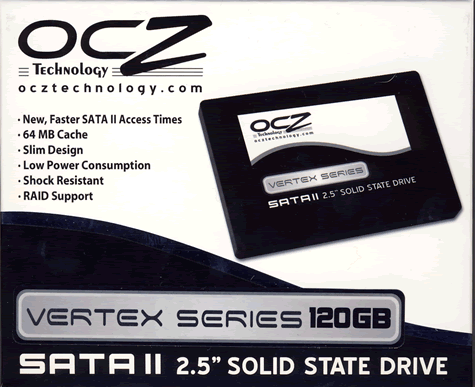
The OCZ Technology Vertex series drives are packaged in an eye catching mainly black and white coloured box. What isn’t picked up on our scan is the striking reflective silver flashing around the edges of the main graphics on the box. Inside the main box is a further box and more robust packaging. The inner box is made from tough cardboard with foam protection. The drive itself is housed in an anti static bag. There should be no problem with the way the drive is packaged.

What’s inside the box


Now it’s time to take a look at the drive itself and what the drive came shipped with.
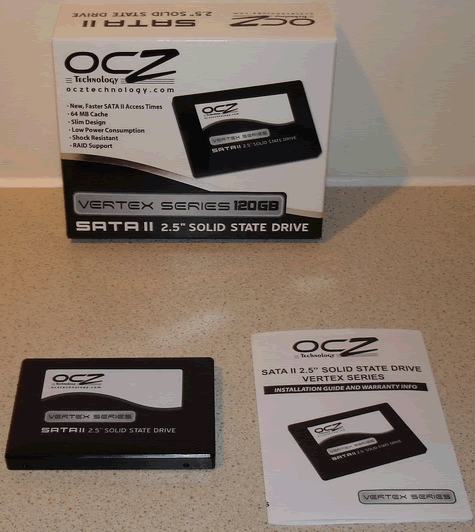
The package contained the drive itself and instruction booklet.

Now let’s take a look at the drive itself.
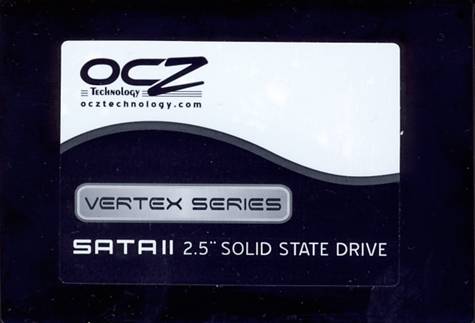
Drive top
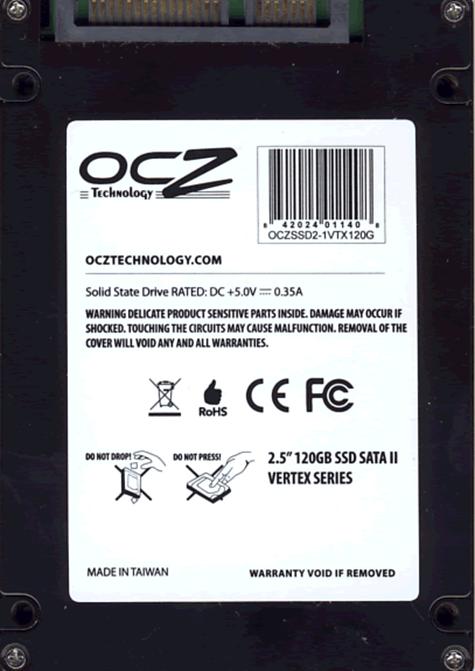
Drive bottom

On the bottom of the drive we can see one label, the label states the drive model number and capacity and, that the drive was manufactured in Taiwan. We can also see the drive’s SATA power and data connectors.

The casing of the drive itself is made of metal and has a tough and high quality feel to it.

Inside the drive
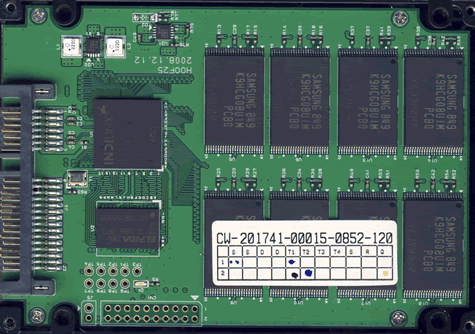
120GB Vertex PCB

Looking at the PCB of the Vertex drive, the first thing we notice is the drive is powered by a new SSD controller, the Indilinx Barefoot. On another chip we can see the drive’s 64MB of cache and that we can also see 8 MLC NAND flash chips manufactured by Samsung.

Let’s take a closer look at the two main chips inside the Vertex.
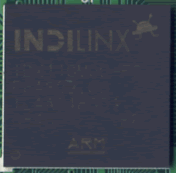
We can clearly see the main controller of the Vertex is the Indilinx Barefoot. This controller is reported to be much more advanced than the previous SSD controllers that OCZ used in their earlier MLC based drives, which were made by JMicron.
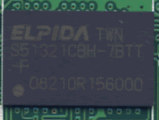
Above we can see the 64MB cache chip, the cache is configured for write-back and helps to smooth the writing process. We should point out that 64MB of cache is fitted to the 120GB and 250GB models only. The 30GB and 60GB models have 32MB of cache.

Specifications and features
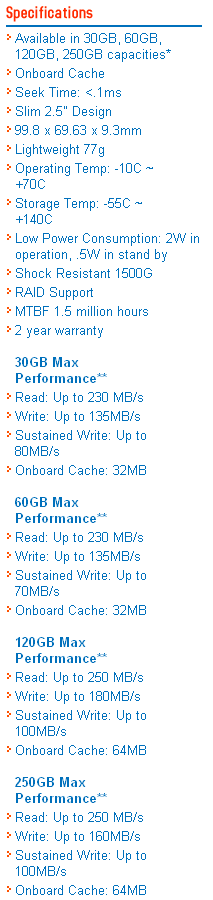

We found the specifications of the drive at the OCZ Technology website.

Reviewers note:

The final specifications of the OCZ Vertex drive were only decided a few short days before we tested the OCZ Vertex drives. OCZ Technology asked their perspective customers what they wanted from Vertex, and OCZ tailored the Vertex firmware to meet these demands. I was witness to this, and I have to say that I was very impressed with OCZ technology, and the way they listened to what their customers wanted from Vertex.

All tests in this review were carried out using the firmware that will ship to the end user.

Now let’s head to the next page where we will test out performance…


Do you want or have this product?

23 Comments

guest
Posts: 15288
Posted on: 26 Feb 09 22:48
Brilliant review, the real-world heavy stutter-free test was particularly convincing. What's the situation with firmware on this drive? (version tested + upgradeability) Any comment about Intel X25-E relative performance? Irregardless, (which is a word and means 'without lack of regard') I will be smashing my piggy-bank very shortly for a new puppy called VERTEX, my laptop demands it!
guest
Posts: 15288
Posted on: 26 Feb 09 22:54
Excelent review! I really see forward to try this drive myself
Chuckwagon
Posts: 163
Posted on: 26 Feb 09 23:01
Great review, lots of effort I'm sure. Wendy, would it be possible to get the IOMeter test suite that was used? I have IOMeter, but it's quite configurable, and everyone seems to use different settings for their tests. I'd like to replicate the tests on my own systems, with the same test setup if possible. Thanks.
guest
Posts: 15288
Posted on: 26 Feb 09 23:01
Really excellent review Wendy, I followed all discussions on the OCZ forums, but I did not expect the difference with the competition to be this big After slashing the prices off ssd's last summer OCZ is again the first to make a mature product for an affordable price. Can't wait to install one.
Chuckwagon
Posts: 163
Posted on: 26 Feb 09 23:52
UNF, I have some Intel X25-E drives. So I downloaded the tests listed, and I'll run them against the X25-E as I get some time. But reporting results in a comment may not be very easy. I guess the easiest test to report in a comment would be the CrystalDiskMark tests, since it's just 3 pairs of numbers. So I'll do that. If you average the CrystalDM results Wendy posted for the OCZ drive you get: Seq - 192.20 59.78 512k - 160.47 69.03 4k - 25.42 12.10 Running 3 tests and taking an average on my Intel drive I got: Seq - 248.83 212.07 512k - 201.80 209.60 4k - 22.12 55.63 Keep in mind that our test systems are different, so the results are not exactly a directly comparable set, but it should give an idea. I'm running a Q6600 2.4Ghz system with 4GB of RAM on a 32-bit XP install. So I'm sure some differences are to be expected.
guest
Posts: 15288
Posted on: 27 Feb 09 03:55
Seriously, love the review, and love the drive!!! Where will these be available to buy first (and when)? I still have a couple of concerns, however, before I make the SSD plunge. These concerns may not be an issue with OCZ SSD drives at all, but they seem to be with some other SSDs. So here goes: - Any word on the rumoured symptoms that affect the only competitor (x25-m/e) being an issue with this drive? For example, will this drive properly prevent (or allow an OS to prevent) defragmenting. The experts say that a total reformat is required to fix the Intel "M.” - And the "E" (SLC) even sounds worse, in that it is said that after only one use, the blocks are required to erase, then re-write - cutting their awesome write performance in half after only one use! (But I get the feeling this phenomenon is common (to a degree) with all SLC SSDs.) - How about the other issue you hear about: the 80% issue? After reaching 80% full, it appears a lot of SSD’s have a heart attack! Which could really prevent the smart shopper from buying the 30 GB drive... if, of course, this is an issue with “this” such drive... How does this drive fair with these issues? Any info anyone? Anyone... Buler?
guest
Posts: 15288
Posted on: 27 Feb 09 07:43
Thanks ChuckW, much appreciated obviously X25-E (slc) has significant advantage in random write speed, whereas reads are not so far apart but considering Intel $12/GB v $4/GB OCZ, I think for my purpose the Vertex will do nicely
guest
Posts: 15288
Posted on: 27 Feb 09 07:45
Where is Intel x25-m? It's the only alternative!
guest
Posts: 15288
Posted on: 27 Feb 09 13:54
One question. For your OS setup, where did you place the pagefile? Was it on the OS SSD or a separate HDD?
guest
Posts: 15288
Posted on: 27 Feb 09 23:58
It's a pity that "results since last update" has been chosen for the iometer test. In this way the measured maximum I/O response time is meaningless - it only shows what happened during the last second of testing! In principle, the maximum I/O response time can prove if the drive is really stutter-free or not, but only if measured with the "results since start of test" setting.
guest
Posts: 15288
Posted on: 28 Feb 09 21:06
The "results since last update" option in IO Meter should -only- be used if you at the same time show us, the readers, how the maximum I/O response time changes during the whole test, how it changes from second to second. If you don't do this the whole test fails as people -will- suspect the result. The simplest way of doing this would probably to run the test again and take a screenshot of the window once every second (there's free software that can easily do this for you, I know for example http://debugmode.com/wink/ can do it). Next enter the values into Excel (or alike) and it will draw a nice diagram for you. This would show us, the readers, so much more than a single "results since last update" and be much more accurate than a single" results since start of test" (I assume this is the reason you decided to go with the "results since last update" instead of the "results since start of test").
Dee
Posts: 10595
Posted on: 01 Mar 09 00:30
Thanks everyone for the input, it very much appreciated, especially the input on iometer, fqvarfort. I will rerun that test over the next few days and amend the review to show the result. I will probably only do that for the review drive though, this time around. I will also make the iometer "test file" available on our forum here at cdfreaks.com, in the review thread. I'll now try and address the other points raised here. Regarding Intel SSD, i don't have one, so i can't compare to that drive. Regarding wear levelling. The reason i ran the tests on the Vertex as an OS drive, was to show what the drive is like in real use, not as blank drive. As to Intel's reported problems on slowing down after use. I can't comment on that. I've read the reports on this, but i prefer not to express an opinion on something that i can't verify for myself.
Dee
Posts: 10595
Posted on: 01 Mar 09 01:24
@cp All Vista settings were default, so the pagefile was also on the Vertex drive. There were no tweaks made to Vista at all for the review. Everything was default.
D111
Posts: 3
Posted on: 01 Mar 09 03:43
Through, meticulous, fair, honest review. :g
guest
Posts: 15288
Posted on: 01 Mar 09 08:49
Agree D111, - but have to be "the consumer" here. It's our money - lot's of them, so my decision isn't final before I see how Vertex compares to some SLC's and x25; the REAL competition :d Hope the best is Vertex - best price price and f Intel! Otto
D111
Posts: 3
Posted on: 01 Mar 09 14:55
Fair enough. A compare to a SLC is patently unfair --- might as well compare it to a $10,000 Enterprise grade SSD. As for the X-25, well, it is a fair compare and no doubt, someone will do the review at some point. I have a certain bias because I did a pretty through review of the architecture of the Vertex controller. It is not without issues - I can see lots of ways to improve its performance going forward, but for a controller built on a 90nm line built to a price point and shipping as of October, it is a decent chip and OCZ's implementation is inspiring.
D111
Posts: 3
Posted on: 01 Mar 09 15:12
Delete duplicate.
This message was edited at: 01-03-2009 15:22
guest
Posts: 15288
Posted on: 01 Mar 09 18:19
Hi Wendy, fqvarfort's proposal of showing the evolution of max I/O response times in the IOMeter test is of course even better than showing the worst result overall, but it's a lot of work! If you can manage that, I would appreciate seeing the results... The first review of the vertex (in PCPer, with pre-shipping firmware) raised some doubts on the drive because of the disappointing results in the dedicated IOMeter tests (workstation pattern etc.) Unfortunately no one has repeated these tests with the shipping firmware, yet. I know these tests are probably not relevant for desktop use of the vertex, but I would really be interested seeing how the final product now scores in these tests, perhaps you can run them as well? Thanks
guest
Posts: 15288
Posted on: 06 Mar 09 06:52
spam removed
jhtalisman
Posts: 2389
Posted on: 06 Mar 09 11:40
Very nice review Dee. Look forward to buying one in the future. :S
guest
Posts: 15288
Posted on: 09 Mar 09 23:41
Wendy is a excellent marketeer, why are other websites not posting reviews. Only 2 results in a google search :d :d :d :g :g :+ :+ :+
Dee
Posts: 10595
Posted on: 10 Mar 09 19:24
That's right Vol. I work hard to promote CD Freaks, and worked extra hard to make sure CD Freaks was the first site to publish a review on the consumer version of Vertex.
guest
Posts: 15288
Posted on: 24 Mar 09 19:21
but will ocz technology be around? http://www.reuters.com/article/rbssCommercialServices%20&%20Supplies/idUSBNG26991320090304

Post a comment

Hello guest,
default
To benefit from all extra features you need to log in or sign up.

About this category

Solid State (ssd)

  • Relatively new way of storing data in PCs / Laptops. Solid State Drives (SSDs) have no moving parts which means they're completely silent. Another advantage is that the more expensive SSDs offer better performance than traditional hard disk drives. However, the prices for these more advanced drives are still rather high and the storage capacity relatively low, preventing SSDs to go mainstream still.More about this
FAQsHow much space is left after I install an OS on my SSD?Should I buy a netbook with a SSD or with an HDD drive?